Darzee
The Jungle BookDarzee is the Tailorbird who helps Rikki-tikki-tavi fight the cobras in the garden of the bungalow at Segowlee cantonment. He is not the principal combatant—Rikki-tikki-tavi does the real fighting—but his nest, his family’s losses, his warnings, and his songs give the conflict its emotional and communal dimension. Through Darzee, the garden’s small creatures experience the cobras’ rule not as an abstract danger but as a daily threat to homes, children, and the fragile work of making a life.
Identity and Family
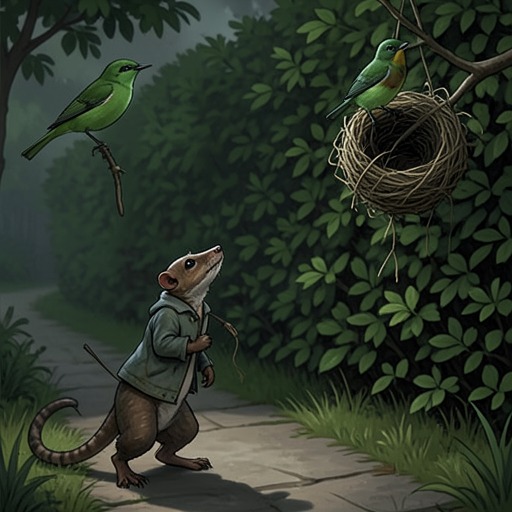
Darzee lives with his wife in a carefully made nest in a thorn-bush. The Tailorbirds have drawn two large leaves together and stitched their edges with fibers, then filled the hollow with cotton and down. The nest is built out of reach of snakes and sways as the birds sit on its rim. Its construction makes Darzee a figure of domestic craft and precarious protection: the birds can create a safe-looking home, but they cannot make the garden safe while Nag and Nagaina remain nearby.
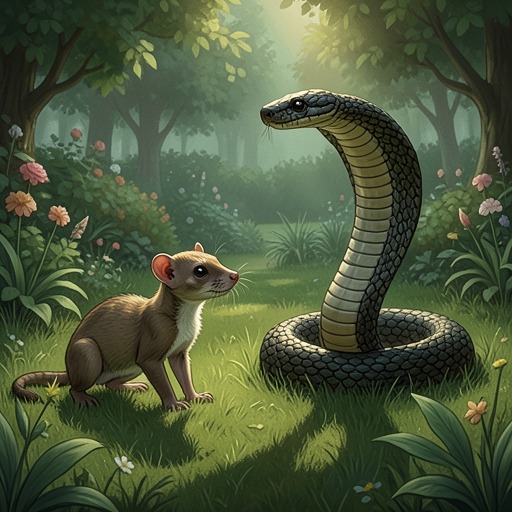
Darzee and his wife are introduced in grief. One of their babies has fallen from the nest, and Nag has eaten it. Darzee tells Rikki-tikki-tavi that the loss has left them miserable, while he and his wife cower rather than answer when Nag’s hiss rises from the grass below. Their fear is immediately justified: Nag emerges as a five-foot black cobra, balancing with his hood spread and watching for the smallest movement. Darzee’s family therefore supplies the first direct evidence of the cobras’ predation and establishes the stakes of Rikki-tikki-tavi’s arrival.
Warnings and Alliance
Darzee becomes an ally almost as soon as Rikki-tikki-tavi meets him. When Nag tries to distract the mongoose by discussing the supposed fairness of eating birds and eggs, Darzee sings a warning: "Behind you! Look behind you!" The warning comes just in time. Nagaina, Nag’s wife, has crept behind Rikki-tikki-tavi to kill him, and he escapes her strike by leaping into the air. Darzee cannot defeat either cobra himself, but his position in the thorn-bush gives him a useful vantage point, and his warning changes the immediate balance from ambush to survival.
His help is limited by fear and by a tendency to become absorbed in the wrong response. After Rikki-tikki-tavi kills Nag, Darzee sings triumphantly from the thorn-bush while the danger is still active. Rikki-tikki-tavi angrily calls him a stupid tuft of feathers and tells him to stop singing and act. Darzee’s song announces Nag’s death to the garden and celebrates the mongoose who held the cobra until the man brought the gun, but it also shows how quickly Darzee mistakes a partial victory for the end of the war. The song is communal memory before it is sound strategy.
The Battle with Nagaina
Rikki-tikki-tavi needs Darzee’s family to help prevent Nagaina’s eggs from hatching. He instructs Darzee to fly to the stables, pretend that a wing is broken, and draw Nagaina away while he reaches the melon-bed. Darzee himself is too distractible to grasp the whole plan, but Darzee’s wife understands its necessity. She knows that cobra eggs will become young cobras, and she performs the diversion by fluttering before Nagaina and crying, "Oh, my wing is broken! The boy in the house threw a stone at me and broke it."
The deception does not fully turn Nagaina, but it delays her long enough for Rikki-tikki-tavi to catch up. Darzee’s wife again flies from the nest and flaps around Nagaina’s head as the cobra moves toward the rat-hole. The distraction is brief, yet it matters: Rikki-tikki-tavi reaches Nagaina just as she enters the hole, seizes her tail, and follows her underground. Darzee’s contribution is therefore indirect but decisive. His wife supplies the practical courage that Darzee lacks in the moment, while Darzee’s earlier warning and his family’s cooperation make the final pursuit possible.
When the grass at the hole’s mouth stops moving, Darzee assumes that Rikki-tikki-tavi is dead. He begins composing a death song, declaring that the mongoose must have been killed underground by Nagaina. The expectation is reversed when Rikki-tikki-tavi emerges covered in dirt, licking his whiskers, and announces that the widow will never come out again. Darzee’s premature mourning becomes another form of comic misjudgment, but it also reveals the danger of the pursuit: even the ally who has seen Rikki-tikki-tavi’s courage believes that following a cobra into its hole is almost certainly fatal.
Songs, Courage, and Narrative Role
Darzee is repeatedly defined through song. His singing preserves the news of Nag’s death, gives shape to the garden’s relief, and turns Rikki-tikki-tavi’s violence into a public victory. Yet the same gift becomes a weakness when it replaces attention to the continuing threat. Darzee’s voice can warn, celebrate, or mourn, but it does not always distinguish between those occasions accurately. His wife’s practical intelligence provides a sharp contrast: she recognizes the danger of the eggs and acts while Darzee continues singing.
That contrast does not make Darzee useless or merely foolish. His warning prevents an ambush, his nest represents a threatened household, and his songs create a shared account of the struggle. He is a witness whose knowledge is incomplete and whose emotions often outrun his judgment, but the story’s resistance to the cobras is collective rather than solitary. Rikki-tikki-tavi supplies physical force; Darzee and his wife supply information, distraction, and the vulnerable domestic world that gives the fighting its purpose. Darzee’s role thus joins the book’s recurring animal-story pattern of danger, testimony, song, and communal survival.